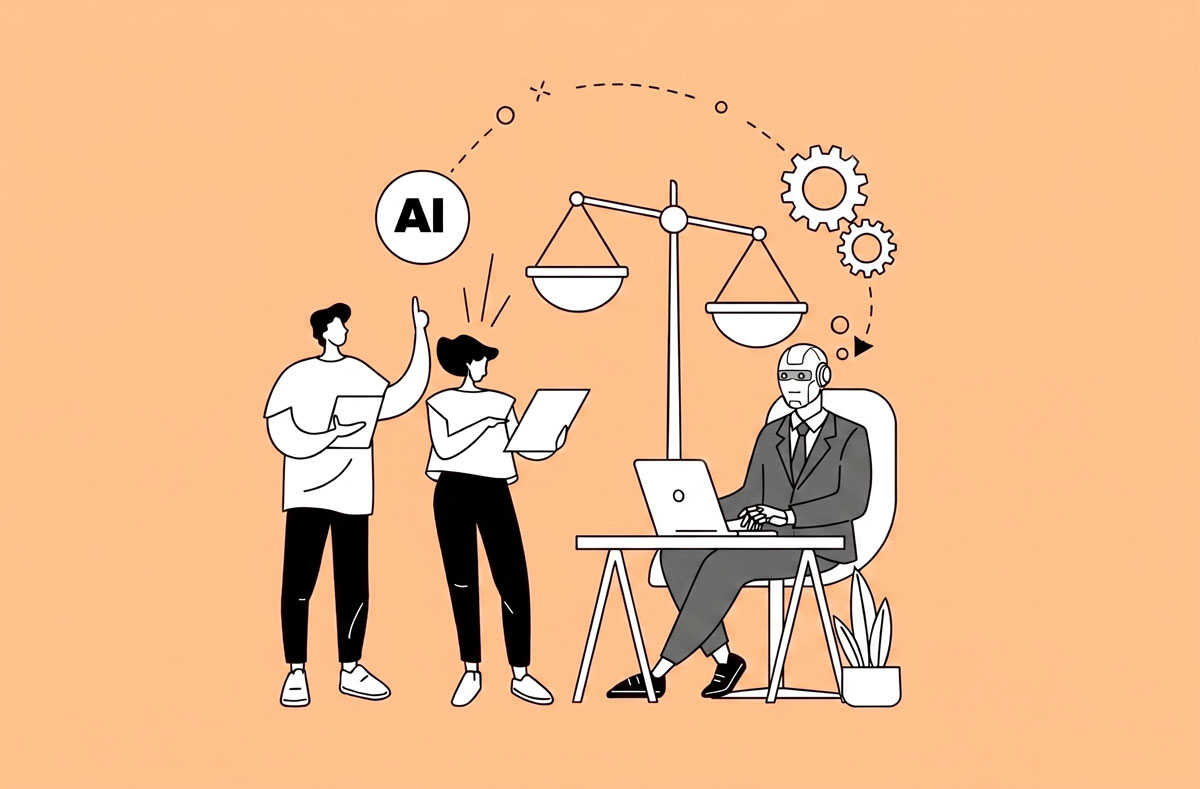
Artificial intelligence has spent the past few years impressing users with how convincingly it can write, summarize and answer questions. Its next test is less glamorous but considerably more important: proving that those answers can be trusted.
AI systems still produce fabricated details, outdated information and confident explanations unsupported by evidence. These failures become far more serious when AI is used to assess job applicants, recommend medical actions, determine access to credit or generate information about identifiable people.
Regulators are therefore beginning to treat accuracy as more than a technical performance target. Depending on how an AI system is marketed and used, inaccurate output can now raise questions involving consumer protection, data protection, discrimination and product safety.
From Annoying Error to Measurable Harm
A chatbot inventing a film credit is irritating. An automated system incorrectly flagging someone for fraud, denying an insurance claim or misidentifying a person through facial recognition can have lasting consequences.
The difference is context. Regulators are generally not demanding that every AI tool answer every question perfectly. They are examining whether a system is sufficiently reliable for its intended purpose, whether its limitations were properly disclosed and whether people can challenge harmful results.
That changes how accuracy must be managed. A company can no longer rely entirely on a disclaimer saying that AI may make mistakes if it simultaneously markets the same product as dependable enough for professional or consequential decisions.
Accuracy Is Not One Number

Regulating AI accuracy is difficult because there is no universal score that describes whether a system is reliable.
A model might perform well on a controlled benchmark but struggle with recent events, regional terminology or questions outside its training data. A facial-recognition system could report strong overall results while producing higher error rates for particular demographic groups. An automated screening tool might appear accurate because it handles common cases well, even though it misses the less frequent cases that matter most.
Regulators and technical evaluators consequently look beyond a headline percentage. They may examine false positives, false negatives, performance across different populations, the quality of testing data and whether results deteriorate after deployment.
Generative AI adds another complication. Unlike a classifier choosing between a limited number of labels, a language model can produce an almost unlimited range of answers. Measuring whether every statement is factual, current and properly supported is much harder than calculating a conventional accuracy rate.
Europe Is Turning Performance Into Compliance
The European Union’s AI Act makes accuracy, robustness and cybersecurity formal requirements for systems classified as high-risk. These include certain applications involving employment, education, essential services, biometrics, critical infrastructure and regulated products.
Providers will be expected to establish appropriate accuracy levels, document relevant performance measures and maintain those standards throughout the system’s lifecycle. Risk management, testing, technical records, human oversight and post-market monitoring are all part of the wider compliance structure.
Implementation remains staggered. Following the EU’s 2026 political agreement on simplifying the AI Act, rules for systems used in areas such as employment, education, biometrics and critical infrastructure are scheduled to apply from December 2027. Requirements for high-risk AI integrated into regulated products are scheduled for August 2028.
The distinction between high-risk applications and general-purpose AI is important. A consumer chatbot is not automatically treated as a high-risk system simply because it occasionally invents information. General-purpose models currently face different obligations centred on areas such as transparency, copyright and systemic-risk management.
In other words, the AI Act is not a universal promise that every AI-generated sentence will be true. It creates stronger performance duties where inaccurate output could affect safety, rights or access to important opportunities.
The United States Is Using Consumer-Protection Law

The United States does not have a single federal law establishing a general accuracy standard for all AI. Existing consumer-protection rules are nevertheless giving regulators a route into the issue.
In July 2026, the Federal Trade Commission proposed a policy statement concerning the suppression of accuracy in AI systems. The proposal focuses specifically on situations in which companies may deliberately steer outputs in ways that conflict with representations made to users. It remains a proposal under public consultation, not a completed rule or a general prohibition against AI hallucinations.
The FTC has already taken enforcement action over more conventional accuracy claims. In one case, an AI-content detector was advertised as 98 percent accurate even though the agency said independent testing showed performance of only 53 percent on general-purpose material. The resulting final order required reliable evidence for future accuracy claims.
The agency has also challenged unsupported claims about facial-recognition performance, including assertions involving accuracy, bias and resistance to spoofing. These cases establish a practical principle: if a company advertises an AI product using impressive performance figures, it needs testing that supports those figures under realistic conditions.
Existing Laws Still Apply
New AI legislation is only one part of the regulatory picture. Privacy, advertising, employment, financial-services and anti-discrimination laws can already apply when AI processes information or influences decisions.
UK data-protection guidance, for example, distinguishes between the legal requirement that personal data be accurate and the statistical accuracy of an AI system. An AI-generated inference does not always have to be correct, but organizations must consider the risk of error, avoid presenting uncertain predictions as confirmed facts and ensure that processing remains fair.
Similar issues arise whenever an AI system generates or changes information about an identifiable person. If an incorrect inference enters a customer record and influences future decisions, the problem is no longer merely that the model “hallucinated.” It may become a question of data correction, lawful processing and individual rights.
Sector-specific oversight can be even stricter. An error rate tolerated in a shopping assistant would be unacceptable in a medical device or safety system. Regulators are increasingly assessing reliability according to the consequences of failure rather than applying one standard to every model.
Evidence Will Matter More Than Marketing
The regulatory shift will force AI companies to become more precise about what their systems can actually do. Broad claims such as “highly accurate,” “bias-free” or “expert-level” may invite scrutiny unless they are supported by competent testing.
Businesses deploying AI will also need to understand the conditions behind a vendor’s performance figures. That includes the data used for evaluation, the languages tested, the populations represented, the age of the results and whether the production system matches the version that was evaluated.
Ongoing monitoring will be just as important as pre-release testing. AI performance can change when models are updated, connected to new data sources or introduced to users whose behaviour differs from the original test population. A system that passed an evaluation six months ago may not perform identically today.
This is likely to encourage more detailed model documentation, independent evaluations, audit trails and mechanisms for correcting errors. Human review will remain necessary in higher-risk settings, particularly when an AI recommendation could materially affect someone’s rights or opportunities.
What It Means for Users

Consumers should not expect regulation to eliminate every incorrect AI response. That would be an unrealistic standard for systems designed to handle open-ended language and rapidly changing information.
What users can reasonably expect is greater clarity. Companies may need to explain what their tools were tested to do, where their limitations lie and how errors can be reported or challenged. Accuracy claims should gradually become narrower and more measurable instead of being treated as decorative marketing copy.
The larger change is one of accountability. AI errors were once described primarily as an unavoidable limitation of an emerging technology. Regulators are now asking who tested the system, what the provider claimed, whether the risk was foreseeable and what happened after the problem was discovered.
Final Byte
AI accuracy is not becoming regulated through a single worldwide rule, nor is every hallucination about to become a legal violation. Instead, accuracy is entering regulation through several doors at once: high-risk AI requirements, consumer-protection enforcement, privacy law and sector-specific safety rules.
For AI companies, sounding convincing will no longer be enough. The next competitive advantage may be something far less flashy but much more valuable: being able to prove when, where and how reliably the system gets things right.